Mobile Site Redesign
The Mobile App Redesign project aimed to address issues of the existing product. This project was undertaken to improve the functionality and user experience of the mobile site, ultimately enhancing customer satisfaction and engagement.

Purpose of Mobile Site Redesign
"A seamless mobile experience isn’t a luxury—it’s a user expectation. This redesign focused on eliminating friction points, improving functionality, and delivering an intuitive interface that meets users where they are."
Research Question
-
Can users interact with the mobile site effectively and efficiently?

Methods
This project employed physiological and qualitative methodologies to address the research questions and gain a comprehensive understanding of issues experienced by users while navigating the original mobile site.
Methods Used
-
Heuristic Evaluation
-
Think-a-loud Protocol
-
Eye Tracking

Heuristic Evaluation
Heuristic evaluation was selected as an initial diagnostic method to efficiently identify usability issues in the existing mobile site. Drawing on the mobile-specific heuristics developed by Inostroza et al. (2012), this method allowed for a structured and expert-driven assessment of core usability principles tailored to mobile interfaces. In this context, the heuristic evaluation helped surface fundamental design flaws—such as inconsistent feedback, poor navigation structure, and lack of user control—that would directly inform the redesign strategy. By highlighting areas of non-compliance with established usability standards, this method laid the groundwork for prioritizing high-impact improvements in functionality and user satisfaction.


Think-A-Loud Protocol
To complement the expert analysis, a think-aloud protocol was conducted to gain direct insight into users’ thought processes and navigation strategies while interacting with the original mobile site. Participants were asked to verbalize their thoughts as they completed a core user task: searching for jobs and selecting a specific job listing. This method revealed real-time usability challenges that may not have been captured through heuristic evaluation alone. The think-aloud sessions helped uncover specific pain points in the user journey and informed targeted design recommendations grounded in actual user behavior.
Eye Tracking Study
To further assess the usability of the mobile site, an eye-tracking study was conducted. Participants were instructed to complete specific tasks—such as locating job filters or selecting a job listing—while their eye movements were recorded. This method allowed us to identify which features were easily located and which required additional visual effort. Patterns in gaze behavior also revealed areas where users’ attention unintentionally drifted, suggesting possible feature placement for the redesign. These insights were essential for understanding the effectiveness of the site’s visual design and informed layout adjustments in the redesign.

RESULTS
The results from each method provided actionable insights that directly informed design improvements for the mobile site to ensure users could navigate efficiently and effectively while using the site.

Heuristic Evaluation Results
Results:
The heuristic evaluation revealed that key functional features were missing from the original mobile site. Users were unable to save their current search criteria for future use, and job listings in the search results lacked critical information—such as whether a position was remote or full-time. These gaps limited the usability and efficiency of the site.
Recommendations Based on Findings:
To address these issues, a dedicated “Save Search” button was added to allow users to quickly revisit their search preferences. Additionally, a standardized layout for job listings was implemented to ensure that essential details (e.g., job type and remote eligibility) are clearly presented at a glance.

Think-a-Loud Protocol Results
Results:
Findings from the think-aloud study echoed those of the heuristic evaluation. Users reported difficulty filtering listings by remote or in-person positions, struggled to save jobs of interest, and expressed frustration with the inconsistent presentation of job information across listings. These inconsistencies increased cognitive load and reduced user confidence in navigating the site.
Recommendations Based on Findings:
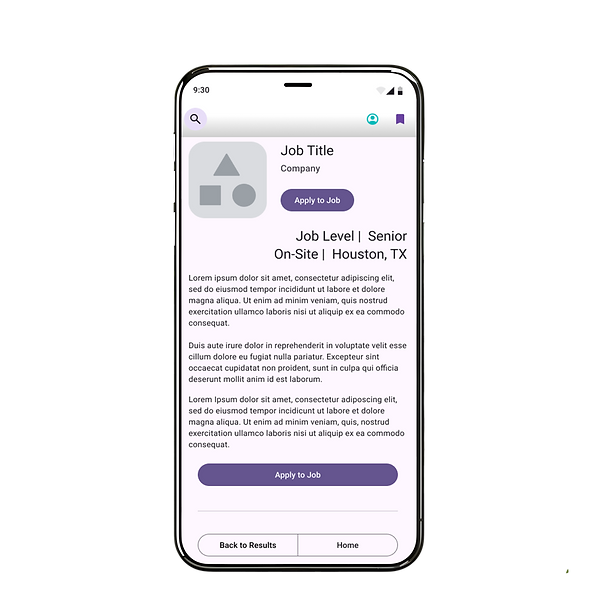
To improve clarity and usability, job listing information was standardized across the platform. A dedicated filter was introduced to easily toggle between remote and in-person positions, and intuitive icons were added to let users save individual job postings with a single tap.
Eye Tracking Results
Results:
Eye movement data revealed that users consistently began scanning the mobile site approximately one-third of the way down the screen, directing attention downward before returning to the top only if needed. Features placed in the top quarter of the screen were often overlooked during initial interactions, leading to delayed discovery of key information.
Recommendations Based on Findings:
To align with natural viewing patterns, essential interactive features and decision-making tools were repositioned within the bottom two-thirds of the screen. This placement increases visibility, supports faster task completion, and better matches user behavior on mobile devices.
Final Design
Below are mockups of the mobile site redesign based on the abovementioned results. The first mockup highlights job listings from a specific search while the second mockup shows the standardized template for each job description.